Step 4: Providing Liquidity & LP Mining
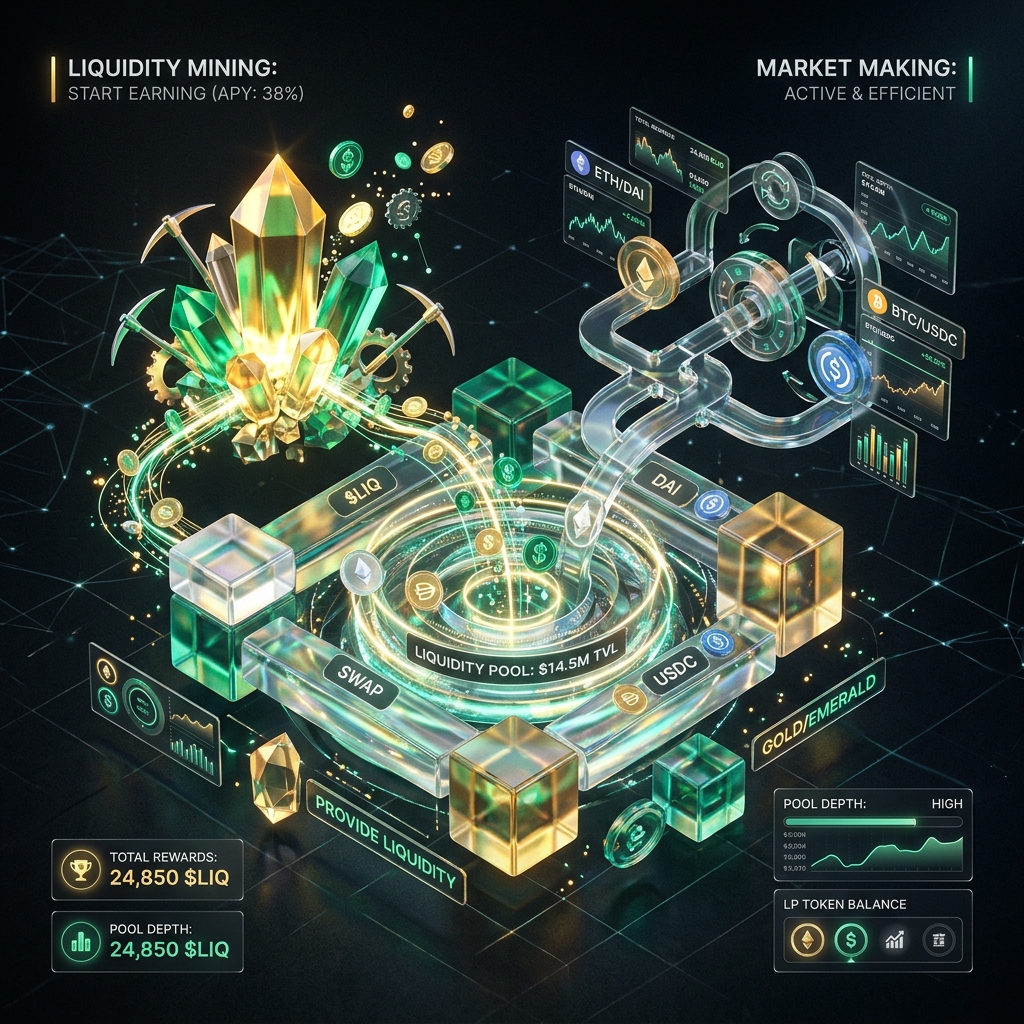 On the DeSix platform, you can participate not only as a trader betting on probabilities, but also as a Liquidity Provider (LP) to share in the protocol's growth. Simply put, LPs act as the "co-owners/house" of the platform.
1. Why do LPs make money? (Mathematical Expected Edge)
In the 49-choose-1 AMM model with odds of 48.5x, the platform possesses a natural mathematical expected edge (House Edge): $$\text{Expected LP Return Ratio} = 1 - \frac{1}{49} \times 48.5 \approx 1.02%$$ This means that as betting volume grows and the law of large numbers takes effect, for every 100 USDC bet by users, LPs expect to make a steady profit of about 1.02 USDC.
Furthermore, out of the 0.3% protocol fee on each bet, 25% is distributed in real-time to all LPs as cash dividends.
2. LP Triple Yield Structure
By depositing USDC to become an LP, you receive three stacked yield streams:
- Market-making Surplus (USDC): Capital from lost bets directly increases your
lpEquitynet asset value (making your LP shares worth more USDC). - Real-time Fee Dividends (USDC): Whenever someone bets, 25% of the transaction fee is distributed in real-time, withdrawable with a single click on your Me page.
- LP Token Mining ($DESIX): Staking liquidity generates hashrate, which shares in the daily release of $DESIX tokens based on your hashrate share.
3. LP Lockup Periods and Time Multiplier T
When depositing USDC to make markets, you can select different lockup durations. A longer lockup yields a higher mining hashrate multiplier:
| Lockup Duration | Hashrate Multiplier T | Mining Efficiency Boost |
|---|---|---|
| Flexible | 1.0x | Base Efficiency |
| 30-Day | 1.3x | +30% Boost |
| 90-Day | 2.0x | 100% Boost (Doubled) |
Note: The lockup only restricts the withdrawal of your principal. During this period, your USDC dividends and mined token rewards can still be claimed at any time.
4. LP Withdrawal Rules and Risk Controls
To prevent large-capital arbitrage (e.g., depositing during high-risk exposures and instantly withdrawing when risk disappears), the contract enforces strict risk controls upon withdrawal:
- No Active Issue Constraint: When withdrawing, the platform must not have an active betting issue running (
!$.hasActiveIssue). - Fixed Withdrawal Service Fee: Each time you withdraw liquidity, the contract deducts a
0.20 USDCservice fee sent to the treasury to compensate for Paymaster gas sponsor costs. - Solvency Guard: When withdrawing, the remaining LP equity must fully cover the maximum theoretical payout exposure of any closed-but-unsettled issues.
- Oracle Staking Minimum Guard: If you are also a registered oracle node, your remaining LP equity after withdrawal must not fall below the oracle stake threshold (Testnet
1,000 USDC/ Mainnet5,000 USDC), otherwise the withdrawal is rejected to prevent node capital flight.
Now you have mastered the complete test flow and interactions. To learn more about the underlying cryptographic mathematical proofs and token deflation models, please check out the 🔬 Core Economics & Mechanism section.